
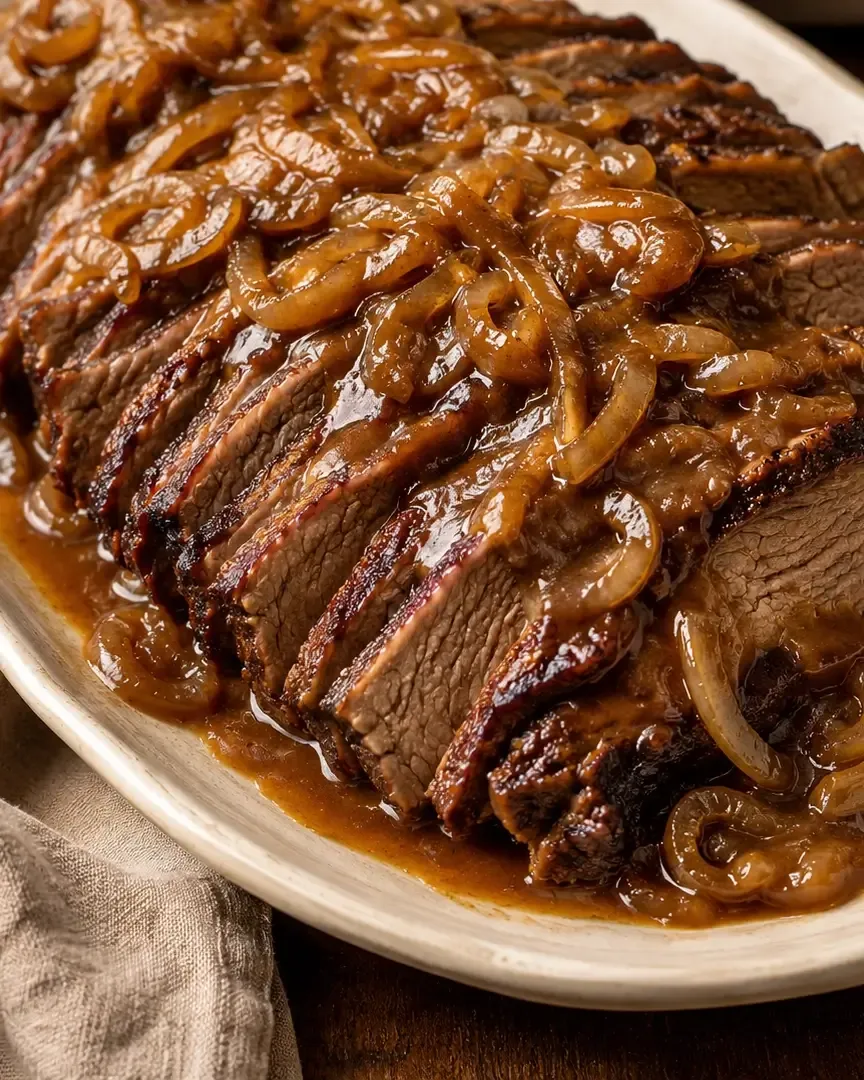
Brisket Recipe
Fork-tender beef brisket braised low and slow with plenty of onions, then finished with a rich, savory onion gravy.
Contains: Milk · Wheat
Check the labels of the beef broth and Worcestershire sauce you use. Formulations vary, and some Worcestershire sauces contain fish or gluten-containing ingredients.
WHY IT WORKS
Why This Recipe Works
01
Low, Slow Braise
A covered low-temperature braise gives brisket time to become tender while the cooking liquid protects it from drying out.
02
Build the Gravy in the Pot
Searing the beef first and cooking the onions in the same pot layers browned flavor directly into the onion gravy.
03
Rest, Then Slice Across the Grain
A short rest and slicing across the grain help the slow-cooked brisket stay juicy and make each slice easier to eat.
WHAT YOU’LL NEED
Equipment
THE RECIPE
Ingredients & Method
Use these cooking tools without leaving the recipe. Change the servings, switch measurements, keep a private note in this browser, and use any timer buttons shown below the method steps.
Ingredient quantities have been scaled. Cooking time, oven temperature, pan size and method timings are unchanged.
My Notes
Ingredients
-
-
-
-
-
-
-
-
Tools
-
-
-
-
-
Tools
Method
Tap a step number as you finish it.
Timed steps show a timer button beneath the instruction.
-
Heat the oven to 300°F. Pat the brisket dry, then season it all over with the kosher salt and black pepper.
-
Heat the olive oil in a large Dutch oven over medium-high heat. Sear the brisket for 4 to 5 minutes per side, until deeply browned. Transfer it to a plate.
-
Reduce the heat to medium. Add the onions and cook for 12 to 15 minutes, stirring occasionally, until softened and lightly browned. Add the garlic and cook for about 30 seconds.
-
Stir in the flour and tomato paste and cook for 1 minute. Gradually pour in the beef broth while scraping up the browned bits from the bottom of the pot. Stir in the Worcestershire sauce, thyme and bay leaves.
-
Return the brisket to the pot, fat side up if it has a fat cap, and spoon some of the onions around it. Bring the liquid to a gentle simmer, cover tightly and transfer the pot to the oven. Braise for 3 1/2 to 4 hours, until a fork or thin probe slides into the thickest part with very little resistance.
-
Transfer the brisket to a cutting board, loosely cover it with foil and let it rest for 20 minutes. Discard the bay leaves and skim off excess fat from the cooking liquid.
-
Set the Dutch oven over medium heat and simmer the onion gravy for 8 to 12 minutes, stirring occasionally, until lightly thickened. Stir in the butter, then taste and adjust the seasoning if needed.
-
Slice the brisket across the grain and arrange it in a serving dish. Spoon the onion gravy over the sliced beef and serve.
COOKING GUIDANCE
Practical Cooking Notes
Doneness
200°F / 93°C
About 200°F is a useful tenderness guide, not a rigid endpoint. The brisket is ready when a fork or thin probe slides into the thickest part with very little resistance.
Make Ahead
Braise the brisket up to 2 days ahead, cool it in the onion gravy and refrigerate it promptly. For neat slices, slice the chilled brisket across the grain, return it to the gravy and reheat gently until hot throughout.
Recipe tools
Adapt This Recipe
Change the quantities, measurements, pan, cooking method or ingredients, then turn what you need into a shopping list.
Recipe Notes
Ingredient Notes
A brisket flat gives neat slices and cooks more evenly than a very thick point. Leave a thin layer of surface fat rather than trimming the beef completely lean; the long braise will render much of it while helping protect the meat.
Useful Substitutions
Low-sodium beef stock can replace the broth in the same quantity. Sweet onions can replace yellow onions, although the finished gravy may taste slightly sweeter.
INGREDIENT QUALITY
Quality Note
Choose a brisket flat with fairly even thickness and a thin layer of fat rather than one trimmed completely lean. Brisket tenderness varies by thickness, so start checking at 3 1/2 hours and keep cooking until a fork or probe slides in with very little resistance.
SPEND LESS
Cost-Saving Tip
Brisket is often better value when bought on sale or as a slightly larger piece. Compare the price per pound, then freeze extra cooked portions in onion gravy for another meal.
COOKING TIPS
Tips
Brown the Brisket Well
A deep brown crust adds savory flavor to both the beef and the gravy. Give the brisket space in the pot and let each side color before turning it.
Cook the Onions Patiently
Let the onions soften and take on a little color before adding the gravy ingredients. Rushing this stage leaves the onion flavor sharper and less rounded.
Keep the Pot Tightly Covered
A tight lid limits evaporation during the long braise. If the liquid is reducing too quickly, add a small splash of broth and cover the pot again.
Slice Across the Grain
Look for the direction of the muscle fibers and cut across them after resting. This shortens the fibers and makes the brisket noticeably easier to chew.
MAKE IT LAST
Storing, Freezing & Reheating
Storing
Refrigerate the cooked brisket and onion gravy within 2 hours in covered, shallow containers and use them within 3 to 4 days.
Freezing
Freeze cooled brisket in meal-size portions with enough onion gravy to keep the meat moist. For best quality, use within about 3 months and thaw overnight in the refrigerator.
Reheat in the Oven
Put sliced brisket and onion gravy in a covered baking dish and warm at 300°F until hot throughout and the center of the meat reaches 165°F.
Reheat in the Microwave
Cover sliced brisket with a little onion gravy and microwave in short intervals until hot throughout and the center reaches 165°F.
ESTIMATED PER SERVING
Nutrition
1 of 8 servings
Nutrition information is an estimate. Where shown, % Daily Value uses standard US Daily Values for adults and children aged 4+; actual values vary with ingredient brands, exact quantities and portion size.
QUESTIONS
Brisket FAQs
What cut of brisket works best for this recipe?
A brisket flat is the easiest choice because its even shape gives tidy slices and relatively predictable cooking. A thicker point can also work, but it may need longer to become tender.
How do I know when brisket is tender enough?
Use tenderness rather than temperature alone. Around 200°F is a useful guide, but the brisket is ready when a fork or thin probe slides into the thickest part with very little resistance.
Can I make brisket with onion gravy ahead of time?
Yes. Braise it up to 2 days ahead, cool it in the gravy and refrigerate it promptly. Chilled brisket is easy to slice neatly, and the slices can then be reheated gently in the onion gravy.
Why is my brisket still tough?
Brisket that is still tough usually needs more time. Keep it covered and continue braising, checking every 20 to 30 minutes, until the connective tissue has softened and a probe slides in easily.
Can I make this brisket in a slow cooker instead?
The flavor profile can be adapted to a slow cooker, but this recipe is developed as a covered oven braise. A slow-cooker version needs different liquid management and timing, so it is better treated as a separate method.

Looking for Something Else to Cook?
Browse more SinOrSlim recipes or use the recipe tools to adapt what you already have.