
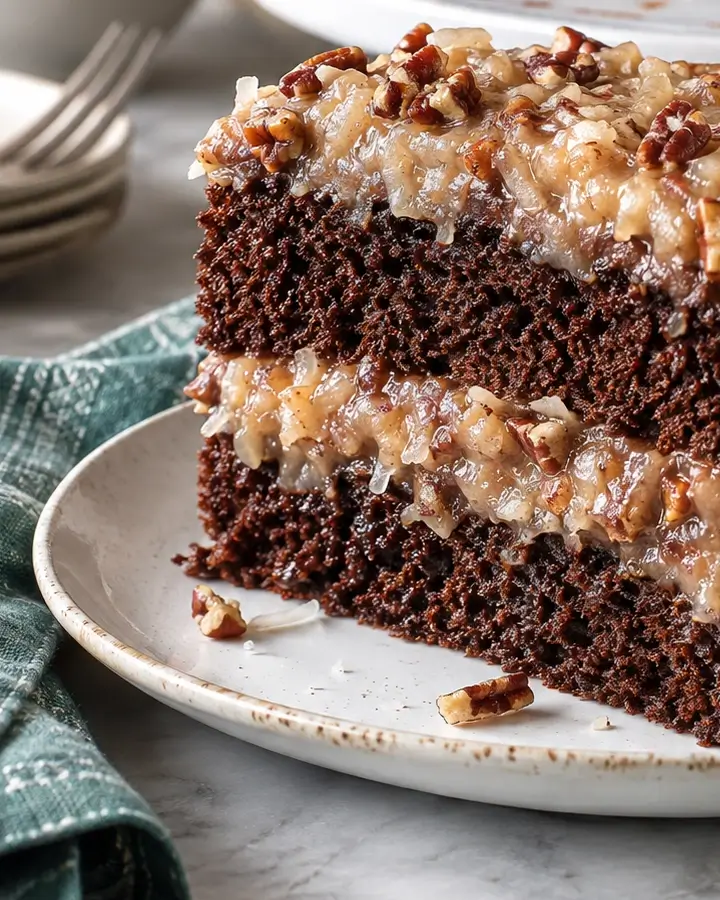
German Chocolate Cake Recipe
Tender chocolate cake layers filled and topped with rich coconut-pecan frosting for a classic homemade German chocolate cake.
Contains: Milk · Egg · Wheat · Tree Nuts · Coconut
This recipe contains milk, egg, wheat, pecans and coconut. Check the labels of the German's sweet baking chocolate and sweetened shredded coconut you use if you are managing allergies, because formulations and cross-contact statements vary by brand.
WHY IT WORKS
Why This Recipe Works
01
Use Sweet Baking Chocolate
German’s sweet baking chocolate gives the cake its characteristic mild chocolate flavor without turning the layers overly dark or bitter.
02
Fold in the Egg Whites
Separately beaten egg whites are folded into the batter at the end, helping the chocolate layers bake up lighter and more tender.
03
Cook the Frosting Until Thick
Heating the milk, egg yolks, sugar and butter until visibly thickened creates a coconut-pecan frosting that stays in place between the layers.
WHAT YOU’LL NEED
Equipment
THE RECIPE
Ingredients & Method
Use these cooking tools without leaving the recipe. Change the servings, switch measurements, keep a private note in this browser, and use any timer buttons shown below the method steps.
Ingredient quantities have been scaled. Cooking time, oven temperature, pan size and method timings are unchanged.
My Notes
Ingredients
- Cake
-
-
-
-
Tools
-
-
Tools
-
-
-
Tools
-
Tools
- Coconut-Pecan Frosting
-
Tools
-
-
-
Tools
-
Tools
-
-
Method
Tap a step number as you finish it.
Timed steps show a timer button beneath the instruction.
-
Heat the oven to 350°F. Grease three 9-inch round cake pans, line the bottoms with parchment paper and lightly grease the parchment.
-
Put the chopped chocolate in a medium heatproof bowl. Pour over the boiling water and stir until the chocolate is completely melted and smooth. Let it cool for about 10 minutes.
-
In a separate bowl, whisk together the all-purpose flour, baking soda and salt.
-
Beat the softened butter and 2 US cups granulated sugar with a stand mixer or hand mixer on medium speed for 3 to 4 minutes, until lighter and fluffy. Beat in the 4 egg yolks one at a time, then mix in the vanilla extract and cooled chocolate.
-
With the mixer on low, add the flour mixture in three additions, alternating with the buttermilk in two additions. Begin and end with the flour mixture and mix only until the batter is evenly combined.
-
In a clean bowl with clean beaters, beat the 4 egg whites until they hold stiff peaks. Fold about one-third of the whites into the chocolate batter to loosen it, then gently fold in the remaining whites until no obvious streaks remain.
-
Divide the batter evenly among the prepared pans. Bake for 28 to 32 minutes, until the centers spring back lightly and a toothpick inserted in the center comes out with a few moist crumbs but no wet batter.
-
Cool the cakes in their pans for 10 minutes. Run a thin knife around the edges, turn the layers onto wire racks, remove the parchment and let them cool completely, about 45 minutes.
-
While the layers cool, combine the evaporated milk, 1 US cup granulated sugar, 3 egg yolks and 1/2 US cup butter in a medium saucepan. Cook over medium heat for 10 to 12 minutes, stirring constantly, until the mixture is bubbling and thick enough to coat the back of a spoon.
-
Remove the saucepan from the heat and stir in the vanilla extract, shredded coconut and chopped pecans. Transfer the frosting to a bowl and let it cool for about 30 minutes, or until thick and spreadable.
-
Place one cake layer on a serving plate and spread about one-third of the coconut-pecan frosting evenly to the edge. Repeat with the second layer, then add the final layer and spread the remaining frosting over the top, leaving the sides exposed.
COOKING GUIDANCE
Practical Cooking Notes
Doneness
The cake layers are done when the centers spring back lightly and a toothpick inserted in the center comes out with a few moist crumbs but no wet batter.
Make Ahead
Bake the cake layers up to 1 day ahead, cool them completely and wrap them tightly at room temperature. The coconut-pecan frosting can be cooked up to 2 days ahead and refrigerated in a covered container; let it soften at room temperature until spreadable before assembling the cake.
Recipe tools
Adapt This Recipe
Change the quantities, measurements, pan, cooking method or ingredients, then turn what you need into a shopping list.
Dietary options
Make This Recipe Work for You
Only straightforward swaps are offered automatically. If changing a defining ingredient would effectively create a different dish, that conversion is left out.
Make It Dairy-Free
Change the following ingredients:
Replace1 US cup unsalted butter, softened
With1 US cup unsalted plant-based butter, softened
Replace225 grams (g) unsalted butter, softened
With225 grams (g) unsalted plant-based butter, softened
Use the same quantity of a plant-based butter suited to cooking or baking as required.
Replace1 US cup buttermilk
With1 US cup unsweetened plant-based buttermilk alternative
Replace240 millilitres (ml) buttermilk
With240 millilitres (ml) unsweetened plant-based buttermilk alternative
Use the same quantity of an unsweetened plant-based buttermilk alternative suitable for the recipe.
Replace1 US cup evaporated milk
With1 US cup plant-based evaporated milk
Replace240 millilitres (ml) evaporated milk
With240 millilitres (ml) plant-based evaporated milk
Use the same quantity of a plant-based evaporated milk alternative.
Replace1/2 US cup unsalted butter, cut into pieces
With1/2 US cup unsalted plant-based butter, cut into pieces
Replace115 grams (g) unsalted butter, cut into pieces
With115 grams (g) unsalted plant-based butter, cut into pieces
Use the same quantity of a plant-based butter suited to cooking or baking as required.
For allergies, intolerances or strict dietary requirements, check the labels of the specific products you use. These swaps do not certify a recipe or ingredient as allergen-free.
Recipe Notes
Ingredient Notes
German’s sweet baking chocolate is milder and sweeter than semisweet chocolate and helps give this cake its familiar flavor. Buttermilk supplies acidity for the baking soda, while the cooked coconut-pecan frosting is a defining part of the finished cake.
Useful Substitutions
If German’s sweet baking chocolate is unavailable, semisweet baking chocolate can be used, although the cake will taste darker and slightly less sweet. For a simple buttermilk substitute, put 1 tablespoon (tbsp) lemon juice in a measuring cup and add whole milk to make 1 US cup; leave it for 5 minutes before using.
INGREDIENT QUALITY
Quality Note
Use German's sweet baking chocolate rather than cocoa powder for the characteristic mild chocolate flavor. Let both the cake layers and coconut-pecan frosting cool completely before assembly so the filling stays thick and the layers remain stable.
SPEND LESS
Cost-Saving Tip
Pecan pieces are often better value than intact pecan halves and work well here because they are chopped for the frosting. Compare the price per ounce and use a store-brand evaporated milk if it is less expensive.
COOKING TIPS
Tips
Use a Clean Bowl for the Whites
Even a little grease or egg yolk can stop the whites from whipping properly, so use a clean, dry bowl and beaters.
Do Not Overbake
Start checking the layers at 28 minutes. A few moist crumbs are fine; waiting for a completely dry toothpick can leave the cake less tender.
Keep the Frosting Moving
Stir the frosting continuously as it cooks so the egg yolks thicken smoothly instead of catching on the bottom of the saucepan.
Cool Before Assembly
Warm cake or warm frosting can make the layers slide. Let both components cool completely before stacking and spreading.
MAKE IT LAST
Storing & Freezing
Storing
Cover the assembled cake and refrigerate it for up to 4 days. For a softer texture and fuller flavor, let individual slices stand at room temperature for about 30 minutes before serving.
Freezing
For the best texture, freeze the unfrosted cake layers. Wrap completely cooled layers tightly and freeze for up to 2 months, then thaw them wrapped at room temperature before assembling. Frosted slices can also be frozen, although the coconut-pecan topping may soften slightly after thawing.
ESTIMATED PER SERVING
Nutrition
1 of 12 servings
Nutrition information is an estimate. Where shown, % Daily Value uses standard US Daily Values for adults and children aged 4+; actual values vary with ingredient brands, exact quantities and portion size.
QUESTIONS
German Chocolate Cake FAQs
What makes German chocolate cake different from other chocolate cakes?
German chocolate cake is an American cake known for its mild sweet-chocolate layers and cooked coconut-pecan frosting. The name comes from German’s sweet baking chocolate rather than from the cake being a traditional German dessert.
Can I make German chocolate cake ahead of time?
Yes. Bake and cool the layers up to 1 day ahead and keep them tightly wrapped. The coconut-pecan frosting can be made up to 2 days ahead and refrigerated; let it soften until spreadable before assembling the cake.
Can I use semisweet chocolate instead of German’s sweet baking chocolate?
You can, but the flavor will be darker and slightly less sweet. German’s sweet baking chocolate gives the cake the milder chocolate profile associated with the classic version.
Why is my coconut-pecan frosting too runny?
The mixture may need a little more cooking or cooling. Cook it until it is visibly thick enough to coat the back of a spoon, then let it cool until it becomes spreadable before assembling the cake.
Do I need to frost the sides of German chocolate cake?
No. This version uses the coconut-pecan frosting between the layers and over the top while leaving the chocolate cake sides exposed, which keeps the defining filling and topping as the focus.
Looking for Something Else to Cook?
Browse more SinOrSlim recipes or use the recipe tools to adapt what you already have.