
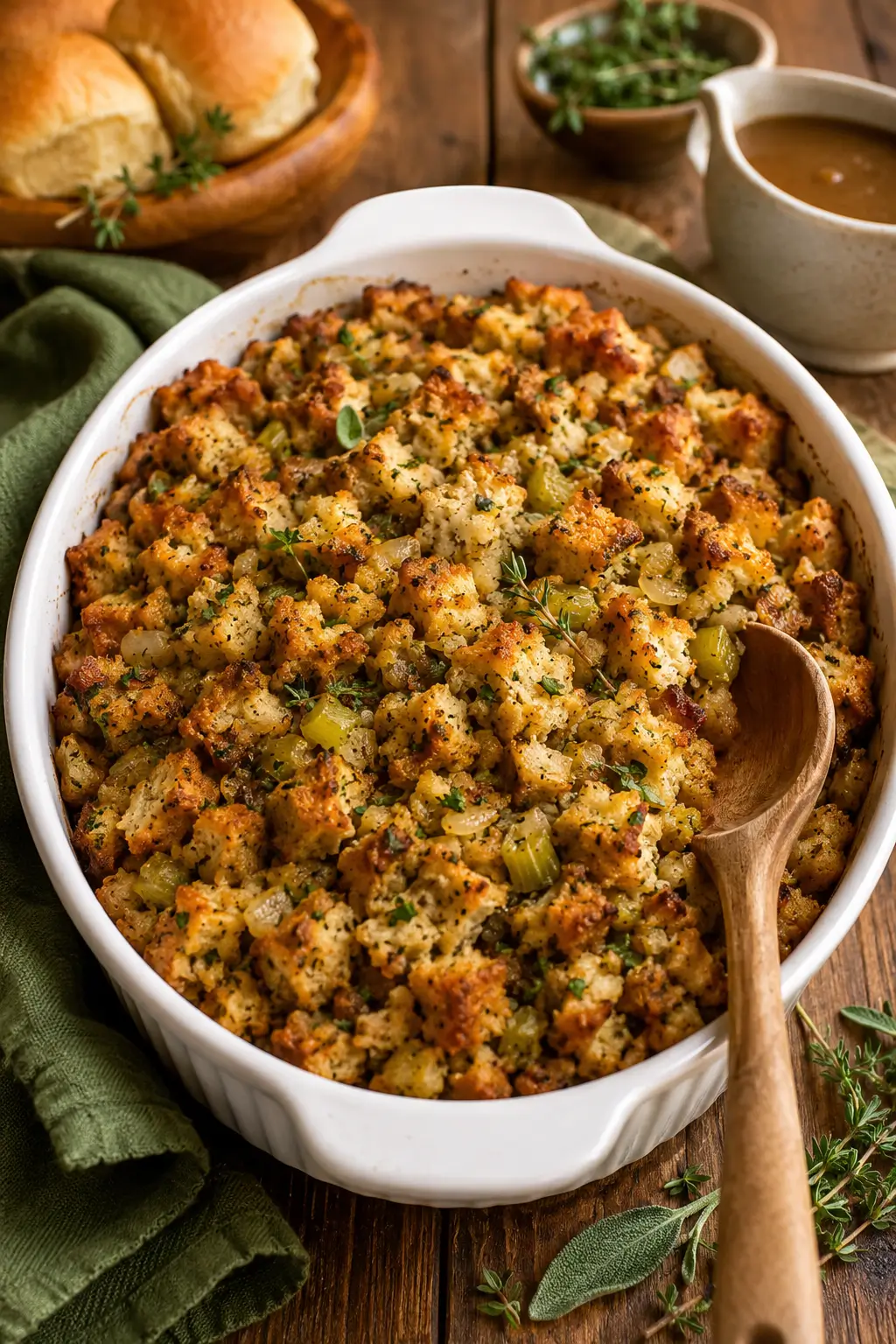
Stuffing Recipe
Homestyle bread stuffing with tender onion and celery, savory herbs, a moist center and crisp golden edges.
Contains: Egg · Milk · Wheat
Check the labels of the bread and vegetable broth you use because formulations vary and may contain additional allergens. The Nut-Free classification describes the authored ingredients and is not a cross-contact certification.
WHY IT WORKS
Why This Recipe Works
01
Dry the Bread First
Drying the bread cubes before mixing helps them absorb the seasoned broth while keeping the finished stuffing tender rather than mushy.
02
Build Flavor in the Pan
Cooking the onion and celery in butter before mixing softens the vegetables and gives the stuffing a deeper savory base.
03
Cover, Then Crisp
Baking covered first keeps the center moist; uncovering for the final stretch gives the top crisp, golden edges while the center reaches 165°F.
WHAT YOU’LL NEED
Equipment
THE RECIPE
Ingredients & Method
Use these cooking tools without leaving the recipe. Change the servings, switch measurements, keep a private note in this browser, and use any timer buttons shown below the method steps.
Ingredient quantities have been scaled. Cooking time, oven temperature, pan size and method timings are unchanged.
My Notes
Ingredients
-
-
Tools
-
-
-
-
-
-
-
-
-
-
Method
Tap a step number as you finish it.
Timed steps show a timer button beneath the instruction.
-
Heat the oven to 300°F. Spread the bread cubes in a single layer on a rimmed baking sheet and bake for about 20 to 25 minutes, stirring once, until dry and crisp but not deeply browned. Remove from the oven, increase the oven temperature to 350°F and lightly butter a 9 by 13-inch baking dish.
-
While the bread dries, melt the butter in a large skillet over medium heat. Add the onion and celery and cook for about 8 to 10 minutes, stirring occasionally, until tender but not browned. Add the garlic and cook for about 30 seconds.
-
Remove the skillet from the heat. Stir in the sage, thyme, salt, black pepper and parsley.
-
Put the dried bread cubes in a large mixing bowl. Add the buttered vegetable mixture and toss gently until the bread is evenly coated.
-
In a medium bowl, whisk the eggs with the vegetable broth until combined.
-
Pour the egg-and-broth mixture over the bread in 2 or 3 additions, tossing gently after each addition. Let the bread stand for about 2 minutes, then toss again. It should be evenly moist with no dry pockets or broth pooling in the bowl. Transfer the mixture loosely to the prepared baking dish.
-
Cover the baking dish tightly with foil and bake at 350°F for 30 minutes.
-
Remove the foil and continue baking for about 20 to 25 minutes, until the top is golden and crisp and the center reaches 165°F on a food thermometer.
-
Remove the stuffing from the oven and let it rest for 10 minutes before serving.
COOKING GUIDANCE
Practical Cooking Notes
Doneness
165°F / 74°C
Check the center with a food thermometer and bake until it reaches 165°F. The top should be golden and crisp while the center remains moist.
Make Ahead
Dry the bread cubes and cook the onion-and-celery mixture up to 1 day ahead. Cool the vegetables promptly, refrigerate them in a covered container and keep the dried bread at room temperature in an airtight container. Combine the bread, vegetables, eggs and broth just before baking rather than refrigerating uncooked mixed stuffing.
Recipe tools
Adapt This Recipe
Change the quantities, measurements, pan, cooking method or ingredients, then turn what you need into a shopping list.
Dietary options
Make This Recipe Work for You
Only straightforward swaps are offered automatically. If changing a defining ingredient would effectively create a different dish, that conversion is left out.
Make It Dairy-Free
Change the following ingredient:
Replace1/2 US cup unsalted butter, plus more for greasing the baking dish
With1/2 US cup unsalted plant-based butter, plus more for greasing the baking dish
Replace115 grams (g) unsalted butter, plus more for greasing the baking dish
With115 grams (g) unsalted plant-based butter, plus more for greasing the baking dish
Use the same quantity of a plant-based butter suited to cooking or baking as required.
Make It Gluten-Free
Change the following ingredient:
Replace1 pound (lb) sturdy white bread, cut into roughly 3/4-inch cubes
With1 pound (lb) gluten-free sturdy white bread, cut into roughly 3/4-inch cubes
Replace450 grams (g) sturdy white bread, cut into roughly 2-centimetre cubes
With450 grams (g) gluten-free sturdy white bread, cut into roughly 2-centimetre cubes
Use a gluten-free bread or loaf with a similar shape and texture.
For allergies, intolerances or strict dietary requirements, check the labels of the specific products you use. These swaps do not certify a recipe or ingredient as allergen-free.
Recipe Notes
Ingredient Notes
Use sturdy white bread rather than very soft fresh bread, and dry the cubes until crisp before adding liquid. Low-sodium broth gives you better control over seasoning because bread can absorb a surprising amount of salt.
Useful Substitutions
Low-sodium chicken broth can replace the vegetable broth if you do not need the stuffing to remain vegetarian. French bread or a plain country loaf can replace the white bread; very soft fresh bread should still be dried thoroughly before mixing.
INGREDIENT QUALITY
Quality Note
Dry the bread cubes until they feel crisp before adding liquid. This gives the bread enough structure to absorb the broth and egg mixture without turning dense or pasty.
SPEND LESS
Cost-Saving Tip
A basic sturdy white loaf works well here; there is no need to buy an artisan loaf because the texture comes mainly from drying the bread thoroughly before mixing.
COOKING TIPS
Tips
Dry the Bread Thoroughly
The cubes should feel dry and crisp at the edges before you add broth. Properly dried bread absorbs flavor without collapsing into a paste.
Add Broth Gradually
Pour in the egg-and-broth mixture in stages and toss gently. The bread should be evenly moistened with no dry pockets or liquid pooling in the bowl.
Do Not Pack It Down
Transfer the stuffing loosely to the baking dish instead of pressing it flat. A little space between the bread cubes helps create a lighter texture and crisp top.
Finish Uncovered
Keep the dish covered for the first part of baking, then remove the foil so the top can brown and crisp without drying the center.
MAKE IT LAST
Storing, Freezing & Reheating
Storing
Refrigerate cooked stuffing within 2 hours in a covered, shallow container and use it within 3 to 4 days.
Freezing
Once fully cooled, freeze the stuffing in airtight portions for longer storage. Thaw frozen portions in the refrigerator before reheating.
Reheat in the Oven
Put the stuffing in a covered baking dish with a small splash of broth and warm in an oven set to at least 325°F until the center reaches 165°F.
Reheat in the Microwave
Cover a portion and heat in short intervals until hot throughout and the center reaches 165°F. Add a teaspoon or two of broth first if the stuffing seems dry.
ESTIMATED PER SERVING
Nutrition
1 of 10 servings
Nutrition information is an estimate. Where shown, % Daily Value uses standard US Daily Values for adults and children aged 4+; actual values vary with ingredient brands, exact quantities and portion size.
QUESTIONS
Stuffing Recipe FAQs
What kind of bread is best for stuffing?
A sturdy white sandwich loaf, French bread or plain country-style white bread works well. The important step is drying the cubes thoroughly so they absorb broth without becoming mushy.
What temperature should stuffing reach?
Cook the center of the stuffing to 165°F as measured with a food thermometer. This applies whether stuffing is baked separately or cooked inside poultry.
Can I make stuffing ahead of time?
You can dry the bread cubes and cook the onion-and-celery mixture ahead, then store them separately. Combine the bread, vegetables, eggs and broth just before baking rather than refrigerating uncooked mixed stuffing.
Why is this stuffing baked separately?
Baking in a casserole dish gives the bread plenty of surface area for crisp edges and makes it easy to check that the center reaches 165°F. It also avoids relying on the cooking time of a whole bird.
How wet should stuffing be before baking?
The bread should be evenly moist and hold together lightly when pressed, but there should not be broth pooling in the bottom of the bowl. If the bread still looks dry after tossing, give it a minute to absorb the liquid before adding more.


Looking for Something Else to Cook?
Browse more SinOrSlim recipes or use the recipe tools to adapt what you already have.