
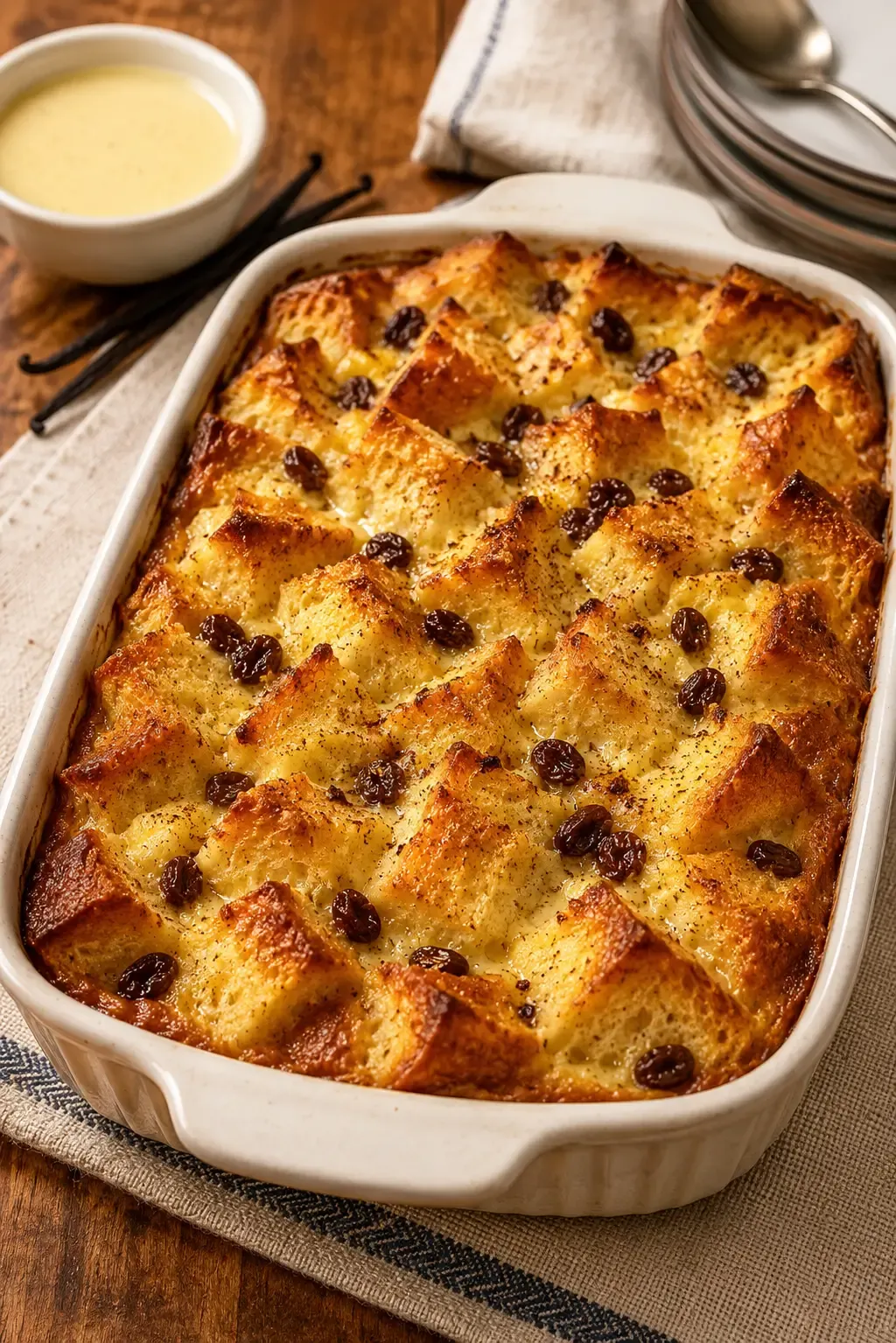
Bread Pudding Recipe
Old-fashioned bread pudding with a soft cinnamon-scented custard center, golden edges, raisins and a smooth vanilla custard sauce.
Contains: Milk · Egg · Wheat
Bread formulations vary, so check the label of the loaf you use for any additional allergens that matter to you. The recipe itself contains milk, egg and wheat.
WHY IT WORKS
Why This Recipe Works
01
Use Day-Old Bread
Slightly dry bread absorbs the egg-and-milk custard evenly while keeping enough structure for a soft, spoonable center.
02
Give It Time to Soak
A 15-minute rest before baking lets the bread take up the custard so the finished pudding is moist rather than watery.
03
Finish with Vanilla Custard
The smooth vanilla custard sauce can be made while the pudding bakes, then spooned over each warm serving just before eating.
WHAT YOU’LL NEED
Equipment
THE RECIPE
Ingredients & Method
Use these cooking tools without leaving the recipe. Change the servings, switch measurements, keep a private note in this browser, and use any timer buttons shown below the method steps.
Ingredient quantities have been scaled. Cooking time, oven temperature, pan size and method timings are unchanged.
My Notes
Ingredients
- Bread Pudding
-
-
-
Tools
-
-
Tools
-
-
Tools
-
-
-
- Vanilla Custard
-
Tools
-
-
-
Tools
-
Tools
-
Tools
-
Method
Tap a step number as you finish it.
Timed steps show a timer button beneath the instruction.
-
Heat the oven to 350°F. Brush a 9 by 13-inch baking dish with 1 tablespoon (tbsp) of the melted butter.
-
Put the bread cubes and raisins in the prepared dish. Drizzle over the remaining 2 tablespoons (tbsp) melted butter and toss gently, then spread the bread into an even layer.
-
In a large bowl, whisk the eggs, 3 US cups milk, 2/3 US cup sugar, 1 tablespoon (tbsp) vanilla extract, cinnamon, nutmeg and 1/4 teaspoon (tsp) salt until smooth. Pour evenly over the bread, press the top cubes gently into the custard, and leave to soak for 15 minutes.
-
Bake for 45 to 50 minutes, until the edges are golden and puffed and the center is set without a pool of liquid custard. Start checking at 45 minutes; for an extra doneness check, the center should reach at least 160°F.
-
While the pudding bakes, make the vanilla custard. In a medium saucepan, whisk 1 1/2 US cups milk, the egg yolks, 1/4 US cup sugar, cornstarch and 1/8 teaspoon (tsp) salt until smooth. Cook over medium-low heat, whisking or stirring constantly, for about 6 to 8 minutes, until steaming and thick enough to coat the back of a spoon. Do not let it boil hard.
-
Remove the custard from the heat and stir in 2 teaspoons (tsp) vanilla extract and 1 tablespoon (tbsp) butter until smooth. Cover the surface or the pan and keep warm, or cool and refrigerate promptly if making it ahead.
-
Remove the bread pudding from the oven and let it rest for 10 minutes so the custard finishes setting and the portions are easier to serve.
-
Serve the bread pudding warm with the vanilla custard spooned over each portion.
COOKING GUIDANCE
Practical Cooking Notes
Doneness
160°F / 71°C
The bread pudding is done when the edges are golden and puffed, the center is set without visible liquid custard, and the center reaches at least 160°F on a food thermometer.
Make Ahead
Assemble the bread pudding through the soaking step, cover and refrigerate it for up to 8 hours, then bake it straight from the refrigerator; allow a few extra minutes if needed. The vanilla custard can be made up to 3 days ahead, chilled promptly and reheated gently before serving.
Recipe tools
Adapt This Recipe
Change the quantities, measurements, pan, cooking method or ingredients, then turn what you need into a shopping list.
Dietary options
Make This Recipe Work for You
Only straightforward swaps are offered automatically. If changing a defining ingredient would effectively create a different dish, that conversion is left out.
Make It Dairy-Free
Change the following ingredients:
Replace3 tablespoons (tbsp) unsalted butter, melted, divided
With3 tablespoons (tbsp) unsalted plant-based butter, melted, divided
Replace45 grams (g) unsalted butter, melted, divided
With45 grams (g) unsalted plant-based butter, melted, divided
Use the same quantity of a plant-based butter suited to cooking or baking as required.
Replace3 US cups whole milk
With3 US cups unsweetened neutral plant milk
Replace720 millilitres (ml) whole milk
With720 millilitres (ml) unsweetened neutral plant milk
Use the same quantity of an unsweetened neutral plant milk; flavor, protein and browning can differ.
Replace1 1/2 US cups whole milk
With1 1/2 US cups unsweetened neutral plant milk
Replace360 millilitres (ml) whole milk
With360 millilitres (ml) unsweetened neutral plant milk
Use the same quantity of an unsweetened neutral plant milk; flavor, protein and browning can differ.
Replace1 tablespoon (tbsp) unsalted butter
With1 tablespoon (tbsp) unsalted plant-based butter
Replace15 grams (g) unsalted butter
With15 grams (g) unsalted plant-based butter
Use the same quantity of a plant-based butter suited to cooking or baking as required.
Make It Gluten-Free
Change the following ingredient:
Replace12 ounces (oz) day-old plain white bread, cut into 1-inch cubes
With12 ounces (oz) gluten-free day-old plain white bread, cut into 1-inch cubes
Replace340 grams (g) day-old plain white bread, cut into 2.5-centimetre cubes
With340 grams (g) gluten-free day-old plain white bread, cut into 2.5-centimetre cubes
Use a gluten-free bread or loaf with a similar shape and texture.
For allergies, intolerances or strict dietary requirements, check the labels of the specific products you use. These swaps do not certify a recipe or ingredient as allergen-free.
Recipe Notes
Ingredient Notes
Use a sturdy, slightly dry white loaf rather than very soft fresh bread. Day-old bread absorbs the custard more evenly and is less likely to collapse into a dense layer; raisins add the familiar sweet bursts throughout.
Useful Substitutions
French bread can replace the plain white bread in the same weight. You can also use 2% milk instead of whole milk in the pudding and sauce, although the finished custard will be a little less rich.
INGREDIENT QUALITY
Quality Note
Slightly dry bread gives a more reliable texture because it absorbs the custard without collapsing. If your bread is very fresh, dry the cubes in a 300°F oven for about 10 minutes and let them cool before assembling the pudding.
SPEND LESS
Cost-Saving Tip
This recipe is a good use for leftover plain bread that is starting to dry out. Save suitable ends and slices in the freezer until you have enough, then thaw them before making the pudding.
COOKING TIPS
Tips
Start with Dry Bread
Day-old bread gives the most reliable texture. If your loaf is very fresh, dry the cubes on a baking sheet in a 300°F oven for about 10 minutes, then let them cool before assembling the pudding.
Give It Time to Soak
Pour the custard evenly over the bread, then press the cubes down gently so the top layer gets moistened without crushing the bread.
Bake Until Just Set
The edges should be golden and puffed while the center is set but still soft. Overbaking can make bread pudding dry and rubbery.
Keep the Sauce Gentle
Cook the vanilla custard over medium-low heat and stir constantly. Gentle heat gives a smooth sauce and reduces the chance of the egg yolks curdling.
MAKE IT LAST
Storing, Freezing & Reheating
Storing
Refrigerate the bread pudding and vanilla custard in separate covered containers within 2 hours and use both within 3 to 4 days.
Freezing
Freeze cooled bread pudding portions in airtight containers for up to about 2 months and thaw overnight in the refrigerator. The vanilla custard sauce is best made fresh or refrigerated rather than frozen, because freezing can make it separate.
Reheat in the Oven
Put portions in a covered baking dish and warm at 325°F until hot throughout. Reheat the custard separately over low heat, stirring often, and add a small splash of milk if it has thickened.
Reheat in the Microwave
Cover an individual portion and microwave in short intervals until hot throughout. Warm the custard separately in short bursts, stirring between each one so it stays smooth.
ESTIMATED PER SERVING
Nutrition
1 of 8 servings
Nutrition information is an estimate. Where shown, % Daily Value uses standard US Daily Values for adults and children aged 4+; actual values vary with ingredient brands, exact quantities and portion size.
QUESTIONS
Bread Pudding FAQs
What is the best bread for bread pudding?
A sturdy day-old white loaf works well because it absorbs the custard without immediately falling apart. French bread is also a good substitute; very soft fresh bread is more likely to turn mushy.
Can I use fresh bread instead of day-old bread?
Yes. Cut fresh bread into cubes and dry them in a 300°F oven for about 10 minutes, then let them cool before adding the custard. This gives them a texture closer to day-old bread.
How do I know when bread pudding is done?
The edges should be lightly browned and puffed, and the center should be set without a pool of liquid custard. For an extra check, the center should reach at least 160°F on a food thermometer.
Can I leave out the raisins?
Yes. The raisins give this version its old-fashioned character, but you can omit them without changing the rest of the method or the baking time.
Can I make bread pudding ahead of time?
Yes. Assemble the pudding through the soaking step, cover and refrigerate it for up to 8 hours, then bake it straight from the refrigerator. It may need a few extra minutes in the oven. The vanilla custard can be made up to 3 days ahead and reheated gently.

Looking for Something Else to Cook?
Browse more SinOrSlim recipes or use the recipe tools to adapt what you already have.