
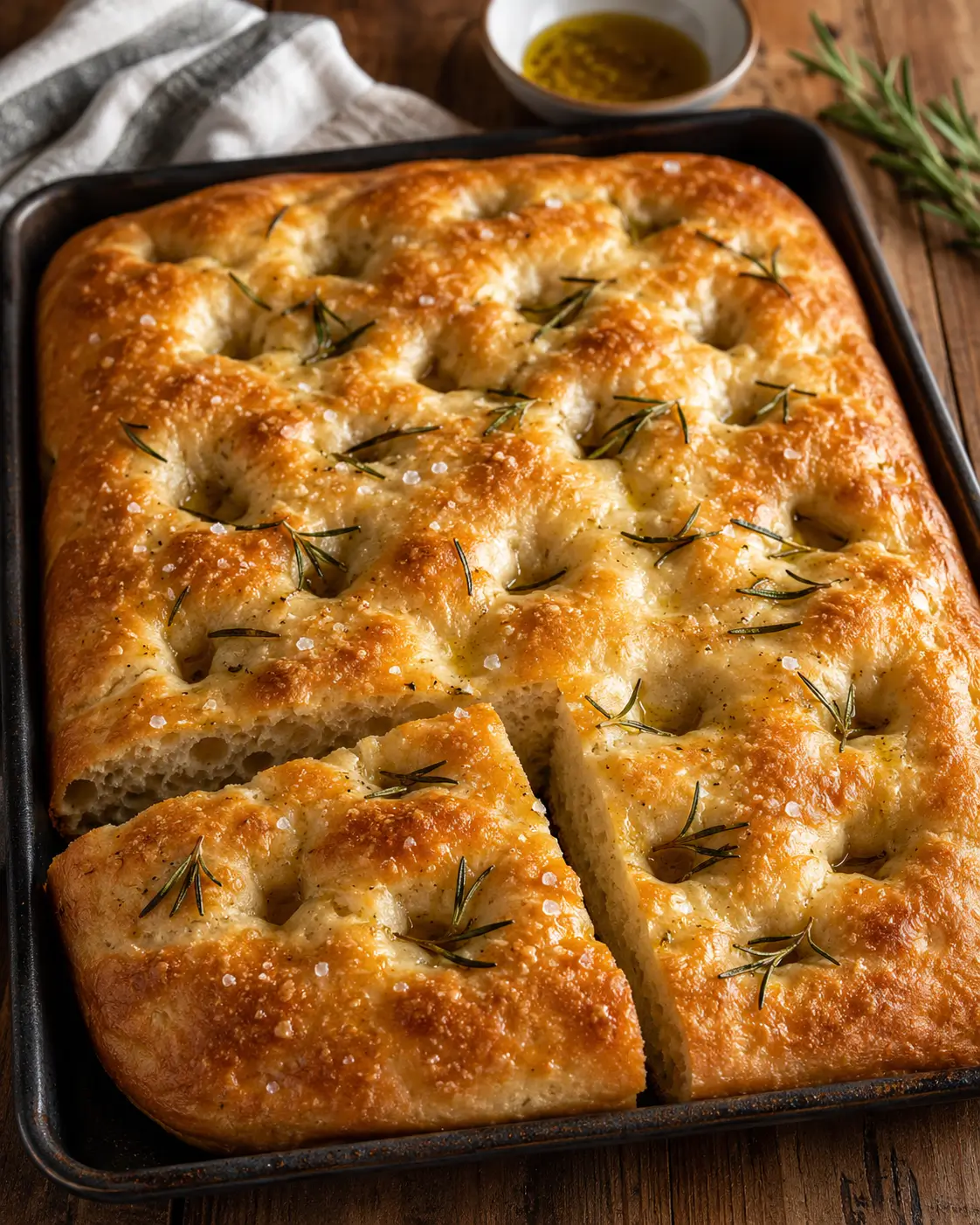
Focaccia Recipe
Soft, airy homemade focaccia with a crisp olive-oil crust, deep dimples and a simple flaky sea salt topping.
Contains: Wheat
Contains wheat. If you are cooking for someone with an allergy, check the labels on the flour and yeast you use for any relevant cross-contact warnings.
WHY IT WORKS
Why This Recipe Works
01
Build an Airy Crumb
A soft, high-hydration dough holds plenty of moisture, helping the focaccia bake up light and open rather than dry or dense.
02
Give It Two Rises
A first rise develops the dough, while the shorter rise in the oiled pan gives the finished bread an even, pillowy lift.
03
Use Olive Oil Generously
Olive oil in the dough, pan and dimples helps create a crisp golden crust while keeping the surface tender and flavorful.
WHAT YOU’LL NEED
Equipment
THE RECIPE
Ingredients & Method
Use these cooking tools without leaving the recipe. Change the servings, switch measurements, keep a private note in this browser, and use any timer buttons shown below the method steps.
Ingredient quantities have been scaled. Cooking time, oven temperature, pan size and method timings are unchanged.
My Notes
Ingredients
Method
Tap a step number as you finish it.
Timed steps show a timer button beneath the instruction.
-
In a large mixing bowl, whisk together the flour, instant yeast, sugar and kosher salt.
-
Add the warm water and 1 tablespoon (tbsp) olive oil. Stir until no dry flour remains and a sticky, shaggy dough forms.
-
Turn the dough onto a lightly oiled work surface and knead for about 6 to 8 minutes, until smoother and elastic but still soft and tacky. Oil your hands lightly if the dough sticks rather than adding extra flour.
-
Return the dough to the bowl, cover and leave it in a warm place for about 60 to 90 minutes, until roughly doubled in size and visibly airy.
-
Coat the bottom and sides of a 9 by 13-inch metal baking pan with 2 tablespoons (tbsp) olive oil. Transfer the dough to the pan and gently stretch it toward the corners. If it springs back, let it rest for 10 minutes, then stretch it again.
-
Cover the pan and leave the dough to rise for about 30 to 45 minutes, until noticeably puffy and relaxed.
-
Heat the oven to 425°F. Lightly oil your fingertips, then press them straight down across the dough to make deep dimples. Drizzle the remaining 3 tablespoons (tbsp) olive oil over the surface and sprinkle evenly with the flaky sea salt.
-
Bake for about 20 to 25 minutes, until the focaccia is deep golden on top, the edges are crisp and the bread pulls slightly away from the sides of the pan.
-
Let the focaccia cool in the pan for 5 minutes, then transfer it to a wire rack. Cool for at least 10 minutes before slicing and serving.
COOKING GUIDANCE
Practical Cooking Notes
Make Ahead
Bake the focaccia up to 1 day ahead, cool it completely, then store it airtight at room temperature. Reheat at 350°F for 5 to 8 minutes before serving to refresh the crust.
Recipe tools
Adapt This Recipe
Change the quantities, measurements, pan, cooking method or ingredients, then turn what you need into a shopping list.
Dietary options
Make This Recipe Work for You
Only straightforward swaps are offered automatically. If changing a defining ingredient would effectively create a different dish, that conversion is left out.
For allergies, intolerances or strict dietary requirements, check the labels of the specific products you use. These swaps do not certify a recipe or ingredient as allergen-free.
Recipe Notes
Ingredient Notes
The dough should feel soft, sticky and slightly elastic after kneading. Resist adding extra flour just to make it easier to handle; a wetter dough is one of the keys to a lighter, airier focaccia.
Useful Substitutions
Bread flour can replace the all-purpose flour for a slightly chewier crumb. Active dry yeast can replace instant yeast; stir it into the warm water with the sugar and let it stand for 5 to 10 minutes before mixing the dough.
INGREDIENT QUALITY
Quality Note
Keep the dough soft and sticky rather than adding extra flour to make it easier to handle. Judge both rises by how puffy the dough looks as well as by the clock.
SPEND LESS
Cost-Saving Tip
A good everyday olive oil works well throughout this recipe; there is no need to use an expensive finishing oil for the full quantity.
COOKING TIPS
Tips
Keep the Dough Soft
The dough is meant to be sticky. Lightly oil your hands instead of adding extra flour, which can make the baked focaccia heavier and drier.
Oil the Pan Well
The oil under the dough is part of the recipe, not just a nonstick measure. It helps fry the base slightly as the focaccia bakes, giving it a crisp golden underside.
Do Not Rush the Final Rise
Wait until the dough looks noticeably puffy before dimpling it. If it still looks tight and flat after 30 minutes, give it another 10 to 15 minutes.
Dimple Without Deflating
Press your oiled fingertips straight down to make deep dimples, but avoid flattening the whole surface so the dough keeps the gas built during proofing.
MAKE IT LAST
Storing, Freezing & Reheating
Storing
Cool the focaccia completely, then keep it in an airtight container or well-wrapped at room temperature for up to 2 days. Refrigeration tends to make bread stale faster.
Freezing
Freeze fully cooled pieces in an airtight freezer bag or container for up to 2 months. Thaw at room temperature, then warm briefly to refresh the crust.
Reheat in the Oven
Warm focaccia on a baking sheet at 350°F for about 5 to 8 minutes, until the surface is lightly crisp and the center is warmed through.
Reheat in the Air Fryer
For a few pieces, air-fry at 325°F for about 3 to 4 minutes. Check early so the edges crisp without the bread becoming dry.
ESTIMATED PER SERVING
Nutrition
1 of 12 servings
Nutrition information is an estimate. Where shown, % Daily Value uses standard US Daily Values for adults and children aged 4+; actual values vary with ingredient brands, exact quantities and portion size.
QUESTIONS
Focaccia FAQs
Why is my focaccia dense instead of airy?
Dense focaccia usually comes from adding too much flour, under-proofing the dough or knocking out too much air while shaping. Keep the dough soft and sticky and let it become visibly puffy before baking.
Can I use bread flour instead of all-purpose flour?
Yes. Bread flour can replace the all-purpose flour and will usually give the focaccia a slightly chewier texture. Keep the same quantity by weight.
Why does the dough spring back when I stretch it?
The gluten is still tight. Leave the dough in the oiled pan for about 10 minutes, then gently stretch it again; it should relax and reach the corners more easily.
How do I get a crisp bottom on focaccia?
Use a metal 9 by 13-inch pan, coat the base generously with olive oil and bake in a fully heated oven. Those three things help the underside brown and crisp.
Can I make focaccia ahead of time?
Yes. For this version, the simplest option is to bake it up to 1 day ahead, cool it completely and store it airtight at room temperature. Warm it briefly in the oven before serving to refresh the crust.
Looking for Something Else to Cook?
Browse more SinOrSlim recipes or use the recipe tools to adapt what you already have.